|
Quick Search
|
Search Results
You searched for: Subject matches "Post Offices" or its children
16 items
items as
Loch Street
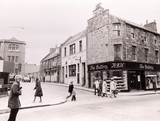
28 Loch Street in the 1980s. Far left, corner of the new Co-op building (1970); left background, St. Paul's Street School (then Aberdeen Education Authority's Music Centre); centre, the Swan Bar, Post Office, The Buttery (A. B. Hutchison). All demolished for the Bon Accord Centre. 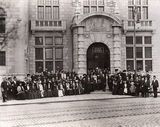
The General Post Office
317 The Staff and guests outside The General Post Office, Crown Street. The building was opened in 1907. W.T. Oldrieve with J. Cumming Wyness (designer). Note the tram lines in the street. 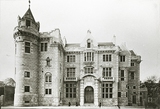
Aberdeen General Post Office, Crown Street
423 Aberdeen General Post Office, Crown Street. Architect J. Cumming Wyness. c.1907. 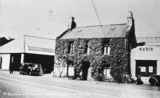
First post office in Cults
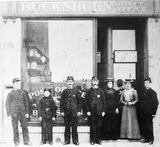
1041 The first post office in Cults was situated on the ground floor of the ivy covered building in the centre of the photograph. The letterbox was on the wall at the right hand side of the doorway. The Sub-Postmaster was Mr Davidson, the blacksmith. In 1900, it was transferred to the present site. 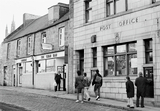
Loch Street, Aberdeen
1192 This 1987 view of Loch Street shows the Swan Bar and the Loch Street Post Office just before their closure. These buildings were at the northern end of the area which was to be demolished for the Bon Accord Centre development. The Swan Bar at no34 was one of the older pubs in Aberdeen and its manager for many years was George Baxter, founder of Aberdeen Darts Association. On its last night on 14th April 1987, it was packed with regulars sad to see their favourite haunt closed down. The Loch Street Post Office, which had been opened in 1939 was closed on 13th April 1987, the staff being redeployed to other branches. 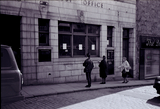
Loch Street Post Office
1201 Loch Street Post Office prior to demolition for the building of the Bon Accord centre. 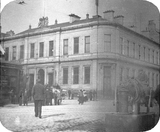
Market Street
1852 A photograph looking north east towards the junction of Guild Street, Market Street and Trinity Quay in 1904.
The then Post Office, on the east side of Market Street, is in the centre of the image with its stone royal coat of arms visible above.
On the right of the image is Fidler's Well, while on the left is the single-storey buildings that were replaced by the Balmoral Temperance Hotel block opened in around 1908. 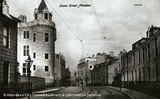
Crown Street
2285 Crown Street, c. 1910. The turretted gable building to the left is the General Post Office, architect W.T. Oldrieve, designer J.C. Wyness. The building was opened in 1907 with considerable fanfare by Mr. Sidney Buxton, the Postmaster General. It cost over 55,000 pounds. To the right and in the centre of the photograph can be noted another superb Edwardian ediface, the Prudential Building of Paul Waterhouse, 1910. In the centre of the picture can be seen the double set of tram lines, together with the overhead cables. 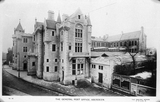
The General Post Office
2286 An Adelphi Series postcard showing the General Post Office, Crown Street, opened in 1907, with designers W. T. Oldrieve and J. Cumming Wyness. 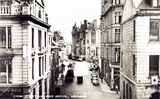
Crown Street from Union Street
2287 Crown Street from Union Street, c.1950s. A postcard image that features the Post Office Headquarters and the Star and Garter pub. 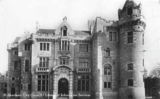
The General Post Office
2288 The General Post Office, Crown Street, Aberdeen. Built 1907 by W T Oldrieve. Later converted into flats. 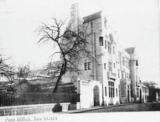
The General Post Office
2289 The General Post Office from Dee Street. The building was opened in 1907. W.T. Oldrieve with J. Cumming Wyness (designer). 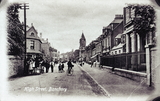
Banchory High Street
2550 A postcard of Banchory High Street, showing the Union Bank on the right in the foreground, the Post Office further back, and the Free Church and West Church in the background. 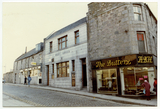
78-80 George Street/32-38 Loch Street
4333 A photograph looking south east at Loch Street, from its junction with George Street, in around 1986 or 1987.
This image is one of a series taken by Aberdeen City Council to record buildings prior to the redevelopment of the area and construction of the Bon Accord Centre.
From right to left, the image shows The Buttery, a bakery of the A. B. Hutchison firm, at 78-80 George Street, a Post Office at 32 Loch Street and the Swan Bar at 34 Loch Street.
On the site of these buildings now stands the north elevation of the Bon Accord Centre to the east of the main George Street entrance. At the time of writing in 2023, the ground floor unit in the centre in this area is occupied by a womenswear shop called Hobbs. 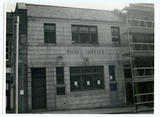
32 Loch Street (Post Office)
4342 A photograph looking south towards the Post Office branch at 32 Loch Street in around 1986 or 1987. Norco House and the Aberdeen Public Soup Kitchen would have been across the road, behind the camera here.
This image is one of a series taken by Aberdeen City Council to record buildings prior to the redevelopment of the area and construction of the Bon Accord shopping centre.
As can be seen below a royal cypher for George VI, this Post Office branch on Loch Street dates from 1939.
Its final day of operation was Monday 13th April 1987. An article covering its closure, to make way for the shopping centre, can be found in the Press & Journal newspaper of that day on page 3.
At its creation this Loch Street branch replaced a Post Office at 242 George Street. Following its closure, the Post Office opened a new branch in the St. Nicholas Centre on Tuesday 15th September 1987 (Press & Journal, 16th September 1987, page 5).
The site shown in the photograph would become the location of part of the Bon Accord Centre's north elevation. |