|
Quick Search
|
Search Results
You searched for: Subject matches "Hospitals" or its children
72 items
items as
Lochhead Hydropathic
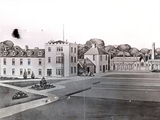
91 Lochhead was a mansion situated near Westburn Park. It was said to be the first hydropathic establishment in Scotland and featured Turkish and Medicated Baths. By the 1890s the building was occupied by the George Washington Wilson optical lantern slide export department. The building was demolished in 1932, and the grounds became part of Westburn Park. 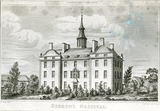
Gordon's Hospital
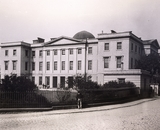
101 Gordon's Hospital from 1731, designed by William Adam, was a school for the education of orphaned boys, endowed by Robert Gordon. His statue, by John Cheere, is seen above the doorway. Although completed by 1739, it was not occupied by pupils until 1750. John Smith remodelled and extended the building in 1833. It became Robert Gordon's College in the 1880s. 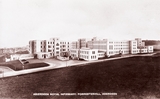
Aberdeen Royal Infirmary, Foresterhill
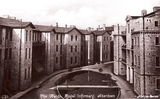
150 Aberdeen Royal Infirmary, Foresterhill, opened in 1936.
This postcard image looks south east and shows the northern side of the general Royal Infirmary building. The photograph must have been taken from around the location of the University of Aberdeen School of Medicine building.
Much of these original buildings remain and and are now surrounded by newer additions to the Foresterhill complex. 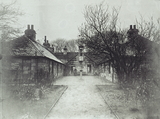
Mitchell's Hospital, Old Aberdeen
171 Mitchell's Hospital is situated in the Chanonry not far from St. Machar's Cathedral in Old Aberdeen. It was founded and endowed in 1801 by David Mitchell, a native of Old Aberdeen. It was set up for the purpose of lodging, clothing and maintaining five widows and five unmarried daughters of Old Aberdeen merchants. The women who lived there dressed in deep blue, and those who were able to earn some money from spinning or knitting were expected to give half to the hospital. The building is of one storey in the shape of a letter 'H' with a central refectory for breakfast. Depending on the cost of beef, dinner was boiled beef and greens two or three times a week, otherwise they had fish or eggs. The building has now been reconstructed into four separate dwellings. 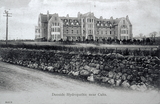
Deeside Hydropathic
209 Deeside Hydropathic at Murtle, five miles to the west of Aberdeen City Centre, was built for the Rev Dr Alexander Stewart in 1899. He had founded a similar establishment in 1874 at Heathcot, Kincardinshire, and the growth of business there led to the selection of this new site close to Murtle Station on the Deeside Railway. It was also seen as a convenient centre for visiting the Deeside area. The extensive grounds included a croquet lawn, bowling green and tennis courts, while the Deeside Golf Club was only a mile away. The building itself had 92 bedrooms, there were Turkish, Russian, vapour, electric and spray baths. Since hydropathy was a medical treatment consisting of the external and internal application of water, the proximity of an artesian well supplying abundant pure water was also a feature. After the first World War, the building was sold and converted into Tor-Na-Dee Sanatorium in August 1918, specialising in the treatment of tuberculosis. More recently it has been used as a convalescent hospital, but it is now being re-developed for housing. Dr Stewart was born in 1835 in Coupar, Angus and studied at Glasgow University and did the medical course at Aberdeen University. At his death in 1909, he was Minister of John Street Congregational Church in Aberdeen, having been ordained there in 1864. 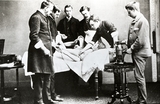
Aberdeen Royal Infirmary, c.1870
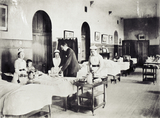
280 An early surgical operation at Aberdeen Royal Infirmary. The fourth figure from the left is Dr Alexander Ogston, the eminent surgeon. An assistant attends to the carbolic spray worked by hand, as used by Lister for the first time in Edinburgh in 1869. The era of sterilised gowns, caps, masks and gloves with antiseptic of dressings, instruments or even the fingers on which Lister later insisted, had not yet arrived. 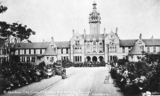
Oldmill Military Hospital, Aberdeen
418 Oldmill Military Hospital, Aberdeen. c.1908. Now known as Woodend Hospital was opened on 15th May 1907. During WWl the hospital was used as a military hospital and sebsequently re-opened as Woodend Hospital in October 1927. This photograph was taken prior to a concert by a pipe band. 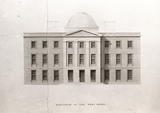
Woolmanhill Hospital
517 Woolmanhill Hospital. Architects drawing of the West Elevation. Designed by Archibald Simpson 1832-1838. 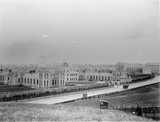
Aberdeen City Hospital
585 Aberdeen City Hospital, Urquhart Road, built as a fever hospital in 1874, later used for elderly patients.
This photograph, which looks south west, was taken from the southern end of Broad Hill. 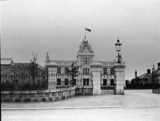
The City Hospital, Urquhart Road
587 The City Hospital, Urquhart Road, built as a fever hospital in 1874, later used for elderly patients. 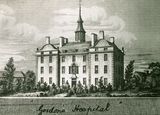
Gordon's Hospital
794 Gordon's Hospital from 1731, began by William Adam. Although completed by 1739, it was not occupied by pupils until 1750. John Smith remodelled and extended the building in 1833. 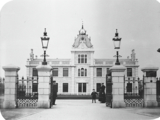
City Hospital, Urquhart Road
800 Aberdeen City Hospital, Urquhart Road, built as a fever hospital in 1874, now used for elderly patients. 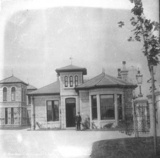
Aberdeen City Hospital lodge
805 Aberdeen City Hospital lodge, Urquhart Road. The hospital was built as a fever hospital in 1874 but is now used for elderly patients. 
Extension work at Aberdeen Royal Infirmary, Foresterhill
877 Extension work at Aberdeen Royal Infirmary, Foresterhill. 
Extension work at Aberdeen Royal Infirmary, Foresterhill
878 Extension work at Aberdeen Royal Infirmary, Foresterhill. 
Extension work at Aberdeen Royal Infirmary, Foresterhill
879 Extension work at Aberdeen Royal Infirmary, Foresterhill. 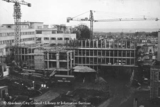
Extension work at Aberdeen Royal Infirmary, Foresterhill
880 Extension work at Aberdeen Royal Infirmary, Foresterhill. 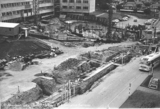
Extension work at Aberdeen Royal Infirmary, Foresterhill
881 Extension work at Aberdeen Royal Infirmary, Foresterhill. 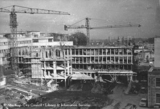
Extension work at Aberdeen Royal Infirmary, Foresterhill
882 Extension work at Aberdeen Royal Infirmary, Foresterhill. 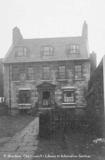
Gilbert Gerard's House (The Girl's Hospital) 1787 in the Gallowgate
1496 Gilbert Gerard's House 1787 in the Gallowgate. This photograph was taken just prior to demolition in c.1905. This building in the Gallowgate was bought by the managers of the Poors Hospital in the early 1800's as a home for the maintenance and education of orphan boys or boys of very poor parents, and was known as the Boys Hospital. In 1828, it was realised that there was a need for a similar home for girls. The managers decided to acquire another property in the Upperkirkgate to which the boys were transferred and this building became the Girls Hospital in 1829. The girls, aged 6-14 years, were instructed in the 3R's as well as sewing, knitting and household work, for the purpose of finding them positions in service. In 1871, a new building was erected in King Street, when the boys and girls hospital was placed under one roof. This building in the Gallowgate was demolished in 1905 as part of the re-development of the area. 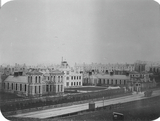
Aberdeen City Hospital, Urquhart Road
1528 Aberdeen City Hospital, Urquhart Road, built as a fever hospital in 1874, and used for elderly patients. |