|
Quick Search
|
Search Results
You searched for: Subject matches "Cults" or its children
47 items
items as
 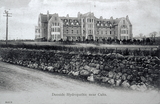
Deeside Hydropathic
209 Deeside Hydropathic at Murtle, five miles to the west of Aberdeen City Centre, was built for the Rev Dr Alexander Stewart in 1899. He had founded a similar establishment in 1874 at Heathcot, Kincardinshire, and the growth of business there led to the selection of this new site close to Murtle Station on the Deeside Railway. It was also seen as a convenient centre for visiting the Deeside area. The extensive grounds included a croquet lawn, bowling green and tennis courts, while the Deeside Golf Club was only a mile away. The building itself had 92 bedrooms, there were Turkish, Russian, vapour, electric and spray baths. Since hydropathy was a medical treatment consisting of the external and internal application of water, the proximity of an artesian well supplying abundant pure water was also a feature. After the first World War, the building was sold and converted into Tor-Na-Dee Sanatorium in August 1918, specialising in the treatment of tuberculosis. More recently it has been used as a convalescent hospital, but it is now being re-developed for housing. Dr Stewart was born in 1835 in Coupar, Angus and studied at Glasgow University and did the medical course at Aberdeen University. At his death in 1909, he was Minister of John Street Congregational Church in Aberdeen, having been ordained there in 1864. 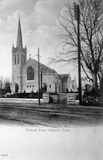
United Free Church, Cults
210 United Free Church, North Deeside Road, Cults. Designed by the architect Duncan McMillan, the church was dedicated in April 1903, and became Cults East Church in 1929. In the early hours of 19 January 1941, a disastrous fire destroyed the building leaving only the spire and stair tower. These remained standing until 2012 when the whole site was cleared for the development of the Cults Kirk Centre. 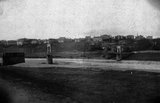
Shakkin' Briggie, Cults
277 Morison's Bridge, more commonly known as the 'Shakkin' Briggie' was built by John Smith. The Reverend George Morison (1757-1845) who was the minister of the Banchory Devenick Church had the bridge built so that his parishioners on the Cults side of the river could worship in his church on the south side of the river. The bridge is now derelict. 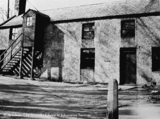
Cults Inn, coach house and stables
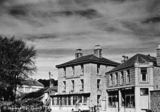
1020 The cottages on the west side of the Cults Hotel. These were once the coach house and stables for the Cults Inn. They were later occupied as shops, shoemaker, tailor and sweetshop.
The buildings were later taken over by Aberdeen Corporation Water Department and were occupied by their workers at the nearby Cults Pumping Station. In 1960, these buildings were demolished and a new public bar was built for the hotel.
When repairs were being carried out on the ground floor house in 1936, then occupied by a Mr James Donald, the hooks and harness pegs from its time as a stable could still be seen behind the linings. These were all removed at the time. 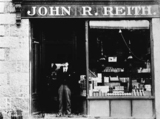
John R. Reith, Chemist, Cults
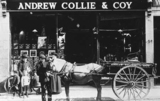
1021 This photograph, from around 1910, shows John Reid Reith standing in the doorway of his chemists shop in Cults - then a village about 3 miles west of Aberdeen. Reith was a native of Cullen in Morayshire but served his apprenticeship in Aberdeen before moving to London for several years. When he came back to Cults, he opened this business. He was involved in many other village activities and was a member of the Cults Fire Brigade. He died in 1926 at the age of 58. The premises shown are still used as a chemist's shop, now known as St. Devenick's Pharmacy. 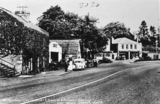
Post Office Corner, Cults
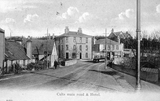
1030 Post Office Corner, Cults, with Cults Hotel hidden by trees, and the white-fronted garage on the left. 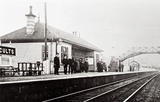
Cults Railway Station
1031 Cults Railway Station, 1920 - Cults was the first main station on the Deeside Line between Aberdeen and Ballater, at 3 and five-eighths miles from Aberdeen.
The line between Aberdeen and Banchory was opened in 1853 and extended to Aboyne and later to Ballater by 1866.
The double line, as seen here, was opened in 1884 and returned to single line in 1951.
This view, from about 1920, shows the stationmaster, Peter Walker, his staff and a number of passengers awaiting the imminent arrival of a train.
In 1894, suburban trains, "subbies", were introduced between Aberdeen and Culter, calling at 8 intermediate stations and covering the 7 miles in just over 20 minutes. This meant that up to 30 trains would be calling at Cults every day.
The "subbies" ceased on 5 April 1937 because of competition from buses. The Deeside Line closed to passenger traffic on 28 February 1966, after the Beeching Report of 1963. Goods traffic continued for a few more months but the final train ran on the line on 30 December 1966.
Cults Station was later occupied by a joinery company. 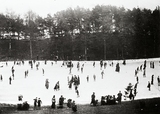
Allan Park Skating Pond, Cults
1032 This wintry scene of iceskaters was taken about 1902/3 in Allan Park, Cults. Allan Park was named after David Allan, a resident of Cults and head of the firm of James Allan and Son, Furnishers. He gifted about 7 acres of land between the Deeside Railway and the River Dee, and the Park was officially opened in June 1897. It was proposed that there should be a curling and skating pond in the centre surrounded with trees and laid out with walks. 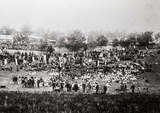
Allan Park
1033 Cutting the first sod for Allan Park at Cults, 26th June 1897. The park was presented by David Allan of West Cults as a gift commemorative of Queen Victoria's Diamond Jubilee.
See the Aberdeen Weekly Journal, 30/06/1897, p. 7, for a full account of this opening ceremony. 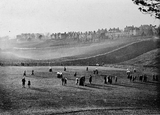
Hockey match in Allan Park, Cults
1034 Hockey match in Allan Park, Cults, c.1900. Allan Park was named after David Allan, a resident of Cults and head of the firm of James Allan and Son, Furnishers. He gifted about 7 acres of land between the Deeside Railway and the River Dee, and the Park was officially opened in June 1897. 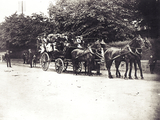
MacPherson outing
1036 This image taken in 1902 shows a horsedrawn coach full of people ready to go on an outing. It had been organised by James MacPherson, joiner in Cults and the photo is taken at the east side of Kirk Brae. Such outings were commonplace at this period when firms organised day trips into the country for their employees. 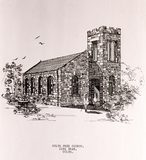
Cults Free Church on Kirk Brae
1037 Cults Free Church on Kirk Brae. The foundation stone was laid by Mr Shirra Gibb on 4th September 1843, and the church was opened in 1844. The sketch is dated July 1956. 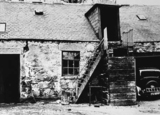
Stables of Alexander Nicol, coal merchants
1038 Stables of Alexander Nicol, coal merchants, Cults, behind the smiddy. 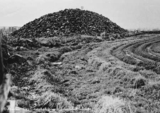
Cults Cairn
1040 Cults Cairn. This round cairn is scheduled as an ancient monument and is probably around 4,000 years old. It was originally one of three but the other two were carted away in December 1892 so that the stones could be used to repair damage to the banks of the River Dee after the massive flooding caused by the 'Muckle Spate'. At this time (1930's) the cairn was in a rural area, but it is now surrounded by a modern housing development in the area between Cults and Bieldside, 3-4 miles west of Aberdeen. It is about 20 metres in diameter and about 5 metres high on a crest overlooking the Dee valley. There was much concern in the late 1970's that the stones were being removed to create paths and rockeries. 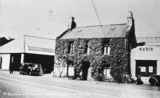
First post office in Cults
1041 The first post office in Cults was situated on the ground floor of the ivy covered building in the centre of the photograph. The letterbox was on the wall at the right hand side of the doorway. The Sub-Postmaster was Mr Davidson, the blacksmith. In 1900, it was transferred to the present site. 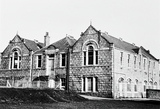
Cults Primary School
1042 Cults Primary School was opened in 1897 to replace Cults Endowed School which had opened in 1866. Cults had grown from a small farming community to a residential area with an increasing population, so a larger school was required. It was built of Rubislaw granite on a two acre site beside the North Deeside Road just west of the centre of the village. The building was replaced in 1974 when a new school was opened in the area where the newer housing in Cults had been built. This old school was put up for sale and was converted into flats with more being built in the playgrounds and at either side of the building. 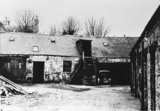
Stables of Alexander Nicol, coal merchant
1043 The stables of Alexander Nicol, coal merchant, Cults, behind the smiddy. 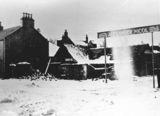
Cults Smiddy demolished
1044 Cults Smiddy demolished. The smiddy was demolished in the 1930s and the house served as the office block for Thomson's Garage which opened in the 1920s. The whole site was later occupied by the complex of buildings forming the Village Garage, which too have been demolished for housing. 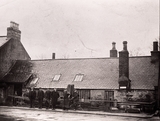
Cults Smiddy
1045 Cults Smiddy stood on the north side of the North Deeside Road, at the bend near the Cults Hotel, where the original centre of this village was. For a long time, the blacksmith was Andrew Davidson, who was also the coal merchant and postmaster. He died in 1906. The gable end at the left side of the photo belonged to Smiddy Cottage, where the Post Office was until 1901. The smiddy was demolished in the 1930s and the house served as the office block for Thomson's Garage which opened in the 1920s. The whole site was later occupied by the complex of buildings forming the Village Garage, which too has been demolished for housing. 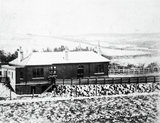
Cults Railway Station
1046 An image looking south showing Cults Station from Ashfield Road.
The exact date of this photograph is unknown but it is thought to be from around the 1940s. |