|
Quick Search
|
Search Results
You searched for: Subject matches "Banks" or its children
30 items
items as
North of Scotland Bank, Aberdeen
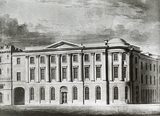
7 In 1838, the North of Scotland Bank purchased the New Inn and other properties at the corner of Castle Street and King Street. The architect Archibald Simpson was invited to submit plans for the Bank's Head Office on the cleared site. This is a photograph of one of his designs which was not accepted. It shows a building with a curved corner topped with a dome and Corinthian columns running through the first and second floors supporting a pediment over an elaborate cornice. The plan which was adopted also had three storeys but the entrance was a Corinthian portico at the corner topped with an open platform with a terracotta sculpture group by James Giles, representing Ceres, goddess of plenty. 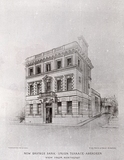
Aberdeen Savings Bank, Union Terrace
11 Engraving of the New Aberdeen Savings Bank, Union Terrace. Designed by William Kelly, 1896. Thomson and Duncan, collo-type, Aberdeen W. and J. Smith and Kelly, architects 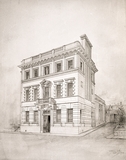
Aberdeen Savings Bank, Union Terrace
178 Aberdeen Savings Bank, Union Terrace, 1894. Aberdeen Savings Bank was established in May 1815 "for receiving such small sums as may be saved from the earnings of tradesmen, mechanics, labourers, servants etc". As the bank became more successful, they moved from premises in the Guestrow to a new building in Exchange Street. By the 1890s, the directors decided that a new site was necessary, especially as the population in the city was moving westwards. This illustration, by the architect William Kelly in 1894, shows the building that was to be constructed at the junction of Union Terrace and Diamond Street at a cost of £11,000. The design is of Renaissance style, with the central entrance leading to an inner porch lined with red and grey granite, then a short flight of steps led to the main telling office. This office had a deeply panelled ceiling and dome partially filled with painted and decorated glass. Coats of Arms of the City and Lord Provosts were also displayed. The counter and desks were made of mahogany and oak with wrought iron and wrought copper grills. In the 1960s, a large extension was built on an adjacent site and, in 1983, the bank became part of the Trustees Savings Bank in Scotland and in 1999 became part of Lloyds TSB. 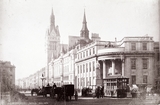
Castlegate, Aberdeen
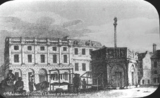
271 The Castlegate, Aberdeen looking west towards Union Street, showing the spires of the Town House and Tolbooth. The building on the right at the corner of Union Street and King Street, was designed by the architect Archibald Simpson as the North of Scotland Bank, later Clydesdale Bank. After its closure as a bank, the building was refurbished and opened in 1997 as a pub named 'The Archibald Simpson'.
In the foreground is the statue of the 5th Duke of Gordon which is now in Golden Square. Adjacent to the statue is the shelter used by cab drivers. 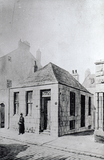
Old Savings Bank, Guestrow
760 Aberdeen Savings Bank was founded in 1815 and had conducted its business in these small offices on the Guestrow until 1858, when the bank was relocated to Exchange Street.
Correspondent Ed Fowler got in touch with Local Studies in order to complete this description:
"Aberdeen Savings Bank was formerly Baillie Alexander Galen's House. Here the first Aberdeen National Security Savings Bank at No.17 Guestrow and perhaps Galen's Court is No.19 as suggested by the larger numeral on the right of the doorway. The building is isolated between the lesser arch of No.15 on the left the and the mysterious Trader's Yard (Galen's Court) on the right. A modest and unassuming structure for the frugal Aberdonians to deposit their spare Bawbees and Mecks." 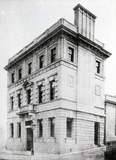
The Aberdeen New Savings Bank
764 The new Aberdeen Savings Bank, Union Terrace. Designed by William Kelly, 1896.
Aberdeen Savings Bank was established in May 1815 'for receiving such small sums as may be saved from the earnings of tradesmen, mechanics, labourers, servants etc'. As the bank became more successful they moved from premises in the Guestrow to a new building on Exchange Street in 1858.
By the 1890s, the directors decided that a new site was necessary, especially as the population in the city was moving westwards.
This photograph shows the building that was constructed at the junction of Union Terrace and Diamond Street at a cost of £11,000. The design is of renaissance style, with the central entrance leading to an inner porch lined with red and grey granite, then a short flight of steps led to the main telling office. This office had a deeply paneled ceiling and dome partially filled with painted and decorated glass. Coats of Arms of the City and Lord Provosts were also displayed. The counter and desks were made of mahogany and oak with wrought iron and wrought copper grills.
In the 1960's a large extension was built on an adjacent site, and in 1983 the bank became part of the Trustee Savings Bank in Scotland, and in 1999 became part of Lloyds TSB. 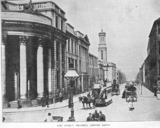
King Street from Castlegate
1454 King Street at the junction with the Castlegate and Union Street. The imposing building on the left is the Headquarters of the North of Scotland Bank. It later became a pub called "The Archibald Simpson" (2007). The church spire belongs to the Trinity Church, King Street, which was converted in the 1960s into Aberdeen Arts Centre. 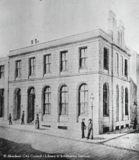
Aberdeen Savings Bank
1936 Aberdeen Savings Bank was founded in 1815 and had conducted its business in small offices until 1st July 1858, when this building was opened on Exchange Street. The ground had been feued from the Scottish North-Eastern Railway Company in January 1857 and this building erected at a cost of around 2,800 pounds. As the population of the city moved further west away from the city centre, the directors felt that a change of site was desirable and, having acquired land in Union Terrace, a new, much larger, office was opened in 1896. 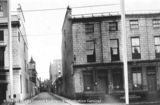
208 Union Street
2113 Royal Exchange Assurance and Liverpool and London Globe Insurance Co premises, 208 Union Street. This photgraph is part of a survey of Union Street from 1936. 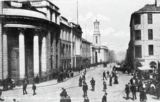
King Street
2194 Looking down King Street from Castle Street, with the spire of the North Church (later the Arts Centre). 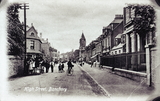
Banchory High Street
2550 A postcard of Banchory High Street, showing the Union Bank on the right in the foreground, the Post Office further back, and the Free Church and West Church in the background. 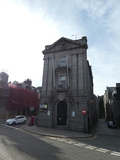
33 Regent Quay
2748 A photograph of the south elevation of 33 Regent Quay taken in July 2018.
This long and narrow, neo-classical building, located at the bottom of Marischal Street, was designed by Robert Gordon Wilson and was built in 1901-02.
It was constructed as a harbour branch for the Aberdeen Town and County Bank. The bank occupied the ground floor. The first floor was occupied by offices for Messrs W. Leslie and Co., shipowners and there were further offices on the third floor.
The building of the new bank entailed the removal of a adjoining house in which the then late Baillie Berry had carried on his business as an optician for many years previous. This building had a sculpted figure known as "The Admiral" over its door.
Robert Gordon Wilson was apprenticed to Alexander Ellis, worked in the office of Alexander 'Greek' Thomson and later became Ellis's partner. 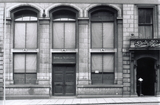
Burlington House and 40 Union Street
2828 The entrance to Burlington House (38 and a half) on Union Street in 1937. This was a hotel of sorts at the time run by Miss Maie Bradley. The Bank of Scotland can also be seen at 40 Union Street. James Macdonell was the then bank agent. 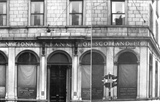
67 Union Street
2842 National Bank of Scotland, Limited, at 67 Union Street in 1937. On the right of the image is the start of Market Street. 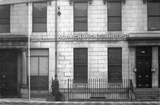
224-226 Union Street
2845 Norwich Union Chambers at 224 and North of Scotland Bank Ltd. (West-End branch) at 226 Union Street in 1937. 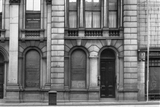
60-62 Union Street
2854 The entrance to 60 and North of Scotland Bank Ltd. (St Nicholas branch) at 62 Union Street in 1937. Horne & Mackinnon, stock and share brokers, can be seen above the bank. 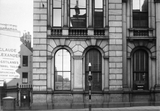
62 Union Street and St. Nicholas Street
2855 North of Scotland Bank (St. Nicholas branch) at 62 Union Street in 1937. Horne & Mackinnon, stock and share brokers, can be seen above the bank. St. Nicholas Street is on the left of the image. 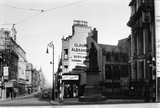
Union Street and St. Nicholas Street
2856 Looking north up St. Nicholas Street from Union Street in 1937. The building on the right is the North of Scotland (St. Nicholas branch) at 62 Union Street. 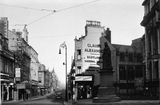
St. Nicholas Street
2857 Looking north up St. Nicholas Street from Union Street in 1937. The statue of Queen Victoria can be seen on the right and behind it Claude Alexander, Ltd., tailors, at 7-11 St. Nicholas Street. 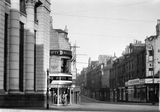
St. Nicholas Street and Union Street
2858 Looking north down St. Nicholas Street from Union Street in 1937. The Commercial Bank of Scotland Limited is on the corner at 78 Union Street and the Fifty Shilling Tailors are at 3 St. Nicholas Street. 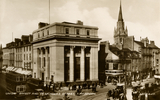
Union Street and St. Nicholas Street
2934 A James Valentine postcard showing Union Street and St. Nicholas Street. The Commercial Bank of Scotland building is in the centre of the image and the The Fifty Shilling Tailor is to the right of it. 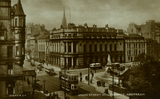
Union Street
2946 A James Valentine postcard image showing the junction of Union Street and Union Terrace. The Palace Hotel and the Northern Assurance Building (Commercial Union Assurance) are visible, as are a tram and various buses. |