|
Quick Search
|
Search Results
You searched for: Subject matches "Other" or its children
83 items
items as
 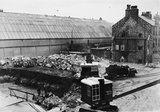
Sandilands: phosphoric acid production plant
842 The foundations for the new phosphoric acid production plant in progress at Sandilands Chemical Plant, following the demolition of houses in Baltic Street. 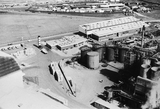
Sandilands: Links Road entrance
843 An aerial view of Sandilands Chemical Works showing the new main entrance to the plant on Links Road.
The maintenance building is to the right of the picture, with the canteen and amenities building to the immediate right of the main entrance.
The sulphuric acid storage tanks are at the front right. There is a carnival in the background across Queen's Links. 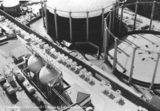
Sandilands Chemical Works
844 Aerial view of Sandilands Chemical Works, showing two liquid ammonia storage spheres in the centre left, railway wagons which delivered liquid ammonia from ICI at the lower left and a gasholder in the gasworks property in the background. 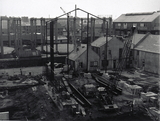
Sandilands Chemical Works
845 Foundation work for the new granulation plant, Sandilands Chemical Works. In the background are the old lodge buildings which became laboratory and office buildings in the later history of Sandilands. The granular fertiliser produced by the new plant was based on ammonium phosphate and as such was a more concentrated chemical fertiliser than that produced on superphosphate base. The batch mixer was replaced by a continuous mixer and the plant produced approximately 20 tons per hour, 24 hours a day, every day. 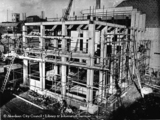
Sandilands Chemical Works
846 Sandilands Chemical Works - structure of the new phosphoric acid production plant well on its way, with reinforced concrete beams and columns. 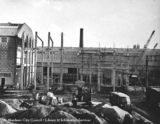
Sandilands Chemical Works
847 Sandilands Chemical Works - foundation work in progress for the new phosphoric acid production plant, with Flemings the timber merchants' chimney in the background. 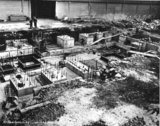
Sandilands Chemical Works
848 Sandilands Chemical Works - foundation work for the new phosphoric acid production plant beside the 20,000 ton phosphate store. 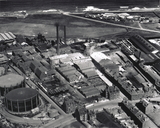
Sandilands: aerial photograph
850 An aerial view of Sandilands Chemical Works looking east towards the sea. This image likely dates from around the mid-20th century.
Some of the houses on Garvock Wynd, the street on the right of this image, have disappeared compared to earlier aerial views. The next street along to the left, with "the Big Hoose" on its corner, is Baltic Street. Miller Street runs along the bottom of the image.
These chemical works began in 1848 when brothers John and George Miller of Paisley leased the land adjacent to gas works that had opened in 1844. Their intention was to process the by-products of coal gas manufacture. The business operated as John Miller & Company, known locally as "stinky Miller's", and went on to manufacture a range of products for North East agriculture.
An obituary for John Miller can be found in the Aberdeen Free Press of 6th March 1894, page 4. An obituary for George Miller featured on page 4 of the Aberdeen Weekly Journal of 11th September 1889.
In around 1928, Miller & Co. became part of Scottish Agricultural Industries (SAI). In the 1930s, the first SAI manager, Mr. Bremner, was appointed and this marked the beginning of the end of the Miller era.
SAI was formed in 1928, part of ICI agricultural division (ICI owned 51%), by combining firms such as J. Miller & Co. in Aberdeen, Milne in Dyce and firms in Carnoustie, Ayr, Edinburgh and Glasgow.
Beyond the chemical works can be seen Queen's Links and the Pleasure Beach across Wellington Street. The esplanade and North Sea are visible beyond. 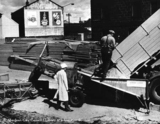
Sandilands Chemical Works
851 Loading powdered fertiliser at Aberdeen Harbour. The loading process involved lorries, conveyors and hoppers. This powdered fertiliser was a patented product of S.A.I. Ltd. (Scottish Agricultural Industries) called phosai and was shipped south to England. The product was based on ammonium phosphate in a very concentrated form. 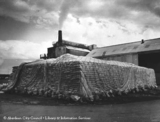
Dyce Chemical Works
852 Dyce Chemical Works (Milnes of Dyce) consisted of a sulphuric acid production plant and a granular fertiliser plant (superphosphate based fertiliser). The site was between Pitmedden Road and the railway line. The photograph shows the fertiliser stored in polythene bags, which replaced hessian sacks, with the acid production plant in the background. The stows were hand-produced by using conveyors and men. They were then covered by large sheets of polythene to prevent the bags from becoming dirty in appearance. 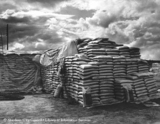
Dyce Chemical Works
853 Dyce Chemical Works (Milnes of Dyce) consisted of a sulphuric acid production plant and a granular fertiliser plant (superphosphate based fertiliser). The site was between Pitmedden Road and the railway line. The photograph shows the fertiliser stored in polythene bags, which replaced hessian sacks. The stows were hand-produced by using conveyors and men. They were then covered by large sheets of polythene to prevent the bags from becoming dirty in appearance. 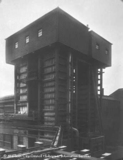
Sandilands Chemical Works
854 Sandilands Chemical Works, Aberdeen. Sulphuric Acid production towers. These towers were filled with inert material (eg granite chips) over which weak sulphuric acid was sprayed from a series of lead pipes at the top of the tower to absorb the SO2 gases which were fed in at the bottom. As a result the liquid collected at the bottom of the tower was a strong sulphuric acid. This acid was then combined with phosphate rock to produce superphosphate fertilisers produced at Sandilands Chemical Works. 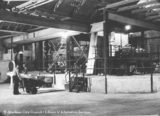
Dyce Chemical Works
855 Dyce Chemical Works (Milnes of Dyce) consisted of a sulphuric acid production plant and a granular fertiliser plant (superphosphate based fertiliser). The site was between Pitmedden Road and the railway line. The photograph shows the fertiliser production plant. Notice the man with the big barrow. All materials were fed into the plant using barrows. There were no mechanical shovels and hoppers here! 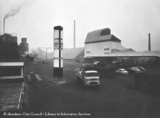
Sandilands Chemical Works
856 The main entrance to Sandilands Chemical Works from Links Road, with the weighbridge. The two chimneys to the left belong to Sandilands. The left hand one was 150 feet high, the other was 200 feet high. The large building to the right was the new bagging plant. 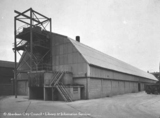
Phosphate store, Sandilands Chemical Works
857 The new phosphate store (capacity 20,000 tons) at Sandilands Chemical Works, built next to the Garvock Wynd boundary wall. The phosphate rock came into Aberdeen from the Pacific Islands and Russia by ship to be unloaded at International Quay and then transferred to Sandilands by lorry. The lorries then tipped their loads into an underground hopper and conveyor system through a grid opening at ground level. The phosphate was then lifted by an elevator to an overhead conveyor from which it was tipped into the store. The material was then trimmed using a bulldozer. One operator was was responsible for the operation of unloading the phosphate including the trimming operation. The phosphate was removed from the store by means of a mechanical shovel and used in the production of phosphoric acid. 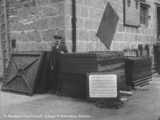
Sandilands Chemical Works
858 Sandilands Chemical Works. Storage tanks for Tar / Ammonia distillate pumped from the Gas Works. John Miller and Co. started business in 1848 having the expertise to convert this distillate into various oils and other products. Gas Works had started in 1844. The sections shown are made of cast iron and were bolted together to form storage tanks. These could be dismantled and re-sited as required. 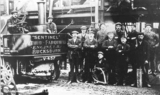
"Sentinel" steam lorry, Arthur Farquhar
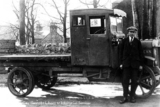
913 "Sentinel" steam lorry, Arthur Farquhar, engineers, Bucksburn. 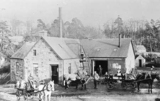
Kennerty Smiddy, Culter
962 Kennerty Smiddy, Culter.
This building was demolished and modern housing now occupies the site. 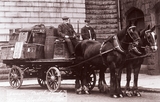
Alec. C. Walker, Carrier
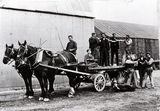
1018 Alec. C. Walker, Carrier. This 1910 photograph shows the delivery cart of Alexander C. Walker, who started in business in the 1880's as a dairyman, then became a carrier from his base in Exchange Street. He was better known in the Cults/Culter area as 'Parcel Sandy', since he collected and delivered laundry baskets from the laundry agents. They would send parcels of linen, sheets and clothes into Aberdeen where the large laundry firms were located. On this trip, he also has a barrel, some sacks and a few planks of wood in his load. 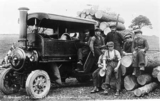
Sawmill Squad, Culter
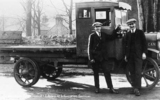
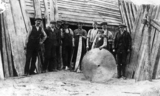
1028 This image from around 1921 shows a squad of saw mill workers from Tom Davie's Mill on Malcolm Road, Culter. Those pictured are: Jocky Shewan, Sammy Stephen, Willie Mundie, Alfy Clark, Robbie Douglas, Dottie Christie and Alec Simpson. The Clayton Steam Wagon (Registration Number FE 2385) with its solid tyres had a top speed of 8mph. The lad sitting on the tree trumps would appear to be aged around 14 or 15 - he had probably only just left school. |