|
Quick Search
|
Home
> Show All
3810 items
items as
Aberdeen Fish Market
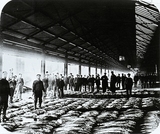
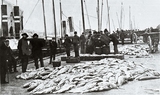
2 Aberdeen Fish Market prior to the building of the covered market in 1889. Steam trawling for white fish was introduced into Aberdeen in 1882 and, in a few years, the fleet of vessels grew to number several hundred and a flourishing new industry was added to the port. 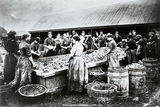
Fishwives
3 Fishwives gutting herring in a yard at Point Law. c.1900. Behind them are the barrels into which the herring would be packed with salt ready for export. 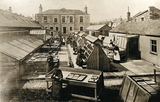
George Washington Wilson's photographic works
4 George Washington Wilson's photographic works at St. Swithin Street, showing the female workers laying out the glass plates to dry in the sun. 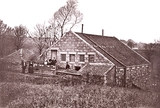
Glenburnie Distillery
5 Glenburnie Distillery stood near to the Denburn, about 100 yards east of the dam in Rubislaw Den, and was reached from Spademill Road. It was in operation until 1857 when the buildings were taken over by Mr G. W. Wilson for photographic printing until 1875. They were later demolished to make way for the construction of Forest Road. This photograph dates from the 1860s. 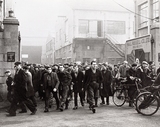
Hall Russell shipbuilders
6 Hall Russell, Ship Builders, Marine Place c. 1950s/60s. Note the main office is off to the right. The entrance at the top of the stairs is to the loft, where scale drawing and templates were drafted. The shipwrights department was on the ground floor to the south of this building.
[Many thanks to Stanley Bruce for providing us with correct details on the building layout.] 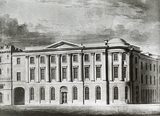
North of Scotland Bank, Aberdeen
7 In 1838, the North of Scotland Bank purchased the New Inn and other properties at the corner of Castle Street and King Street. The architect Archibald Simpson was invited to submit plans for the Bank's Head Office on the cleared site. This is a photograph of one of his designs which was not accepted. It shows a building with a curved corner topped with a dome and Corinthian columns running through the first and second floors supporting a pediment over an elaborate cornice. The plan which was adopted also had three storeys but the entrance was a Corinthian portico at the corner topped with an open platform with a terracotta sculpture group by James Giles, representing Ceres, goddess of plenty. 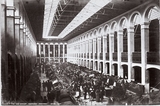
Aberdeen Market interior
8 The interior of the New Market, architect Archibald Simpson. Aberdeen Market, built in April 1842, was burnt to the ground in 1882. It was rebuilt and re-opened in 1883, remaining a popular shopping market until 1971 when it was demolished to make way for the present Market and British Home Stores. c. 1884 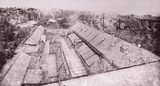
George Washington Wilson's photographic works
9 The premises of George Washington Wilson, photographer, in St. Swithin Street. 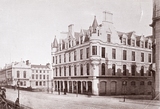
Palace Hotel, Union Street
10 The Palace Hotel, Union Street. Built 1874 for Messrs Pratt and Keith, milliners, who occupied the street level area, it operated as one of a chain of LNER hotels. Its upper stories were destroyed by fire on 31 October 1941 with loss of life, and the building was entirely demolished after the war. 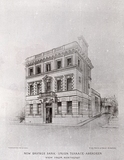
Aberdeen Savings Bank, Union Terrace
11 Engraving of the New Aberdeen Savings Bank, Union Terrace. Designed by William Kelly, 1896. Thomson and Duncan, collo-type, Aberdeen W. and J. Smith and Kelly, architects 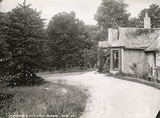
Arrucarias (Monkey Puzzle trees) at South Stocket
12 Arrucarias (Monkey Puzzle trees) at South Stocket 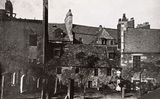
Schoolhill
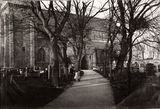
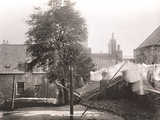
13 Old houses skirting St. Nicholas churchyard once formed part of the south side of Schoolhill. They were demolished in 1884-85 as part of a street widening scheme and the present wall and railing stand in their place. On the other side of Schoolhill (centre) can be seen the roof and turrets of George Jamesone's House, demolished in 1886.
The book Aberdeen in Byegone Days: Views of Streets and Buildings, etc. with Letterpress Description (1910) by Robert Anderson (page 26) suggests that the building in the centre of this image was the home of Burnett Carr, the grave-digger and assistant to the sexton of St. Nicholas Church.
Newspaper references indicate that Carr, a well known figure, died on 31st May 1844 (Aberdeen Journal, 5th June 1844, page 3, column 2).
This photograph looks north and shows the back of Carr's old house. 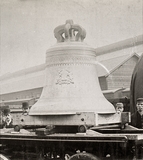
St. Nicholas Bells
14 St. Nicholas Bells, 1887. The great fire of 1874 swept through the East Kirk of St. Nicholas, totally destroying the oak and lead steeple and sending the great bells crashing to the ground. A decade later, the citizens of Aberdeen combined to replace the bells with a great peal of bells cast in Belgium. The bells arrived at Aberdeen Station on May 11th 1887 and were paraded through the city with great pomp and ceremony. 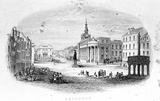
The Castlegate
16 Engraving of the Castlegate, c. 1850. The statue of the last Duke of Gordon, erected in 1844, was removed in the 1950s to Golden Square. Published by G. Shepherd, Broad Street, Aberdeen 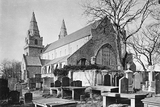
St. Machar's Cathedral
17 St. Machar's Cathedral, Old Aberdeen, showing the east window of 1840s, replaced in 1882. 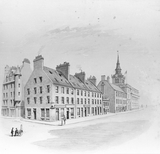
Union Street junction with Broad Street
18 Union Street at its junction with Broad Street, with the tower of the Tolbooth at the right of the photograph. Huxter Row, starting below the tower at the left of the photograph, ran parallel with Union Street to the Old Town House joining Union Street at right angles. These buildings were demolished in the late 1860's and the site is now occupied by the Town House designed by Peddie and Kinnear in 1874. 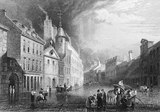
Broad Street looking South
19 Busy scene in Broad Street in 1833, showing buildings on the left hand side which were demolished for the extension and frontage of Marischal College. The archway at the left led through to the original buildings of Marischal College and the original Greyfriars Church. The Water House, surmounted with a pediment and clock, was erected in 1766 as a reservoir for the town's water supply. The clock and its bell were transferred to the City Hospital in 1899. Byron lived with his mother in the tenement block next to the turreted building. On the west side of the street, the tall building in the distance was the first office of the North of Scotland Bank. 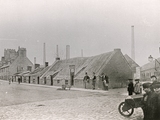
Gilcomston Steps, Skene Square
20 Gilcomston Steps, foot of Skene Square, in 1866. Part of old Gilcomston, these 18th century labourers' houses were known as "the rotten holes" and were among the very worst slums in the city, even by the standards of the mid 19th century. The end house with the sign was used as a smithy. All were demolished to make way for the Denburn Valley Railway, c.1866. 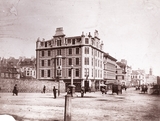
Guild Street
21 Guild Street, Aberdeen looking down towards the harbour, showing the Tivoli Theatre and Criterion Bar. The bar closed in 2012, but planning permission was granted to convert it to retail premises.
The Tivoli reopened in 2013 after major refurbishment, having been closed for a number of years. 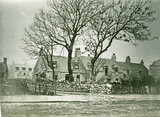
Cottages with drystane dyke
22 Stoneyton, old Skene Road, approximately 300 yards west of Albert Street. Demolished 1875-76 to build part of Carden Place. The houses depicted in the above picture are listed in the Post Office Directory of 1873/74. The thatched building on the left was used as a blacksmiths shop and the other buildings were inhabited mostly by Rubislaw Quarry workers. They were demolished to make room for the erection of modern villas about 1879. 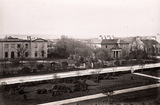
Albyn Place
24 Albyn Place leading west to Queens Road. Aberdeen High School for Girls, designed by Archibald Simpson as Mrs Elmslie's Institution (1837-39) is on the left of the picture. c.1880 |